
On this page
- The short answer
- What can I check from the ground?
- Which way does each sign point?
- Why are hail and capacity part of the decision here?
- How does the money work out?
- What do different gutters usually need?
- When is replacement clearly the better buy?
- When is repair clearly enough?
- What will a contractor check that I cannot?
- How do I keep repaired gutters going?
- The bottom line
The short answer
Repair when the faults are few and local and the metal is straight. Replace when faults are spread across the system, when hail has creased the runs, or when the gutters are too small for the roof. Langford & Sons Gutters connects callers with independent local gutter contractors, who give the estimates and do the work.
What can I check from the ground?
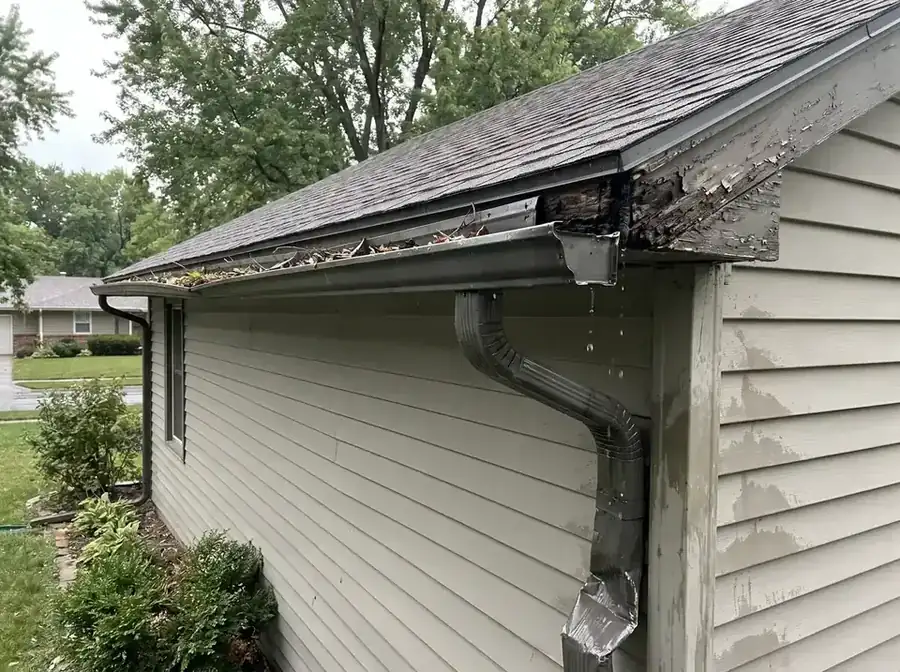
- Sight along each run. Is it straight, with an even fall?
- Look at the face for dents and creases.
- Find the joints. A seam every 10 feet means sectional gutter.
- Look for spike heads on the gutter face.
- Check corners for drip stains.
- Look behind and below for stained fascia and soffit.
- Watch in rain. Where does water come over the edge?
- Check each downspout and where it empties.
Which way does each sign point?
| Sign | Points to | Why |
|---|---|---|
| One or two dripping corners | Repair | Reseal the joints |
| A dip between hangers | Repair | Re-hang |
| A blocked or crushed downspout | Repair | Clear or replace the pipe |
| Dimples from small hail | Leave or replace | Cosmetic; your choice |
| Creases or kinks in several runs | Replace | Metal is deformed |
| Seams leaking along the runs | Replace | Sectional at end of life |
| Sagging on every side | Replace or fully re-hang | All fixings have failed |
| Overflow when clean | Replace or add outlets | Undersized |
| Soft fascia along long lengths | Replace with carpentry | Gutter must come off anyway |
| Roof being replaced after hail | Replace | Same claim, same visit |
Why are hail and capacity part of the decision here?
Two local factors tip borderline cases toward replacement.
Hail. Collin County's record includes the March 2016 storm in which Plano was among the hardest-hit cities. When a roof is replaced under a claim, gutters of the same age are usually damaged too, and replacing them at the same time avoids fitting dented gutter back under a new roof.
Capacity. Many houses carry 5-inch gutter and 2x3 downspouts under roofs with steep valleys. Repairing a system that was never big enough leaves the main problem in place. See 5-inch vs 6-inch gutters.
How does the money work out?
| Work | How it is priced | Typical place in the range |
|---|---|---|
| Reseal joints | Per joint or per visit | Lowest |
| Re-hang a run | Per run or per foot | Low |
| Replace a downspout | Per length | Low |
| Replace one elevation | Per foot of new seamless | Middle |
| Replace everything | Per foot; national guides give $9 to $17 for aluminum | Highest |
A rule of thumb: if the quoted repairs come to more than about half the cost of replacement and the gutters are thin or undersized, replace.
What do different gutters usually need?
- Seamless aluminum, under 15 years, no hail: repairs only.
- Seamless aluminum with hail creases: replace affected runs or all.
- Sectional aluminum on spikes: replace.
- Builder-grade partial gutters over doors only: replace with a full system.
- Vinyl: replace.
- Copper: repair; soldered joints can be redone.
When is replacement clearly the better buy?
- Damage on every elevation.
- A roof replacement is scheduled.
- You are adding guards and the gutters are marginal.
- The fascia needs replacing along most eaves.
- The system overflows at several valleys.
When is repair clearly enough?
- The metal is straight and of decent gauge.
- Faults are at joints, hangers or a single downspout.
- The problem is where the water goes at ground level, which is fixed with extensions or drain lines.
- A cleaning reveals the "leak" was an overflow from a blocked outlet.
What will a contractor check that I cannot?
- Fascia soundness behind the gutter.
- Hanger type and spacing inside the trough.
- Pitch, with a level or by running water.
- Dents in the gutter floor that hold water.
- Drip edge and how the shingles meet the gutter.
- Whether outlets sit at the true low points.
How do I keep repaired gutters going?
- Clean them in April and December.
- Have corners checked each time and resealed when they start to crack.
- Swap any remaining spikes for screw-in hangers.
- Keep ladders off the front lip.
- Record their condition with photographs each year, which also helps if hail strikes.
The bottom line
Count the faults and look at the metal. A few faults in straight gutter is a repair. Many faults, creased runs or chronic overflow is a replacement. Either way, see gutter repair or gutter replacement for what the work involves.